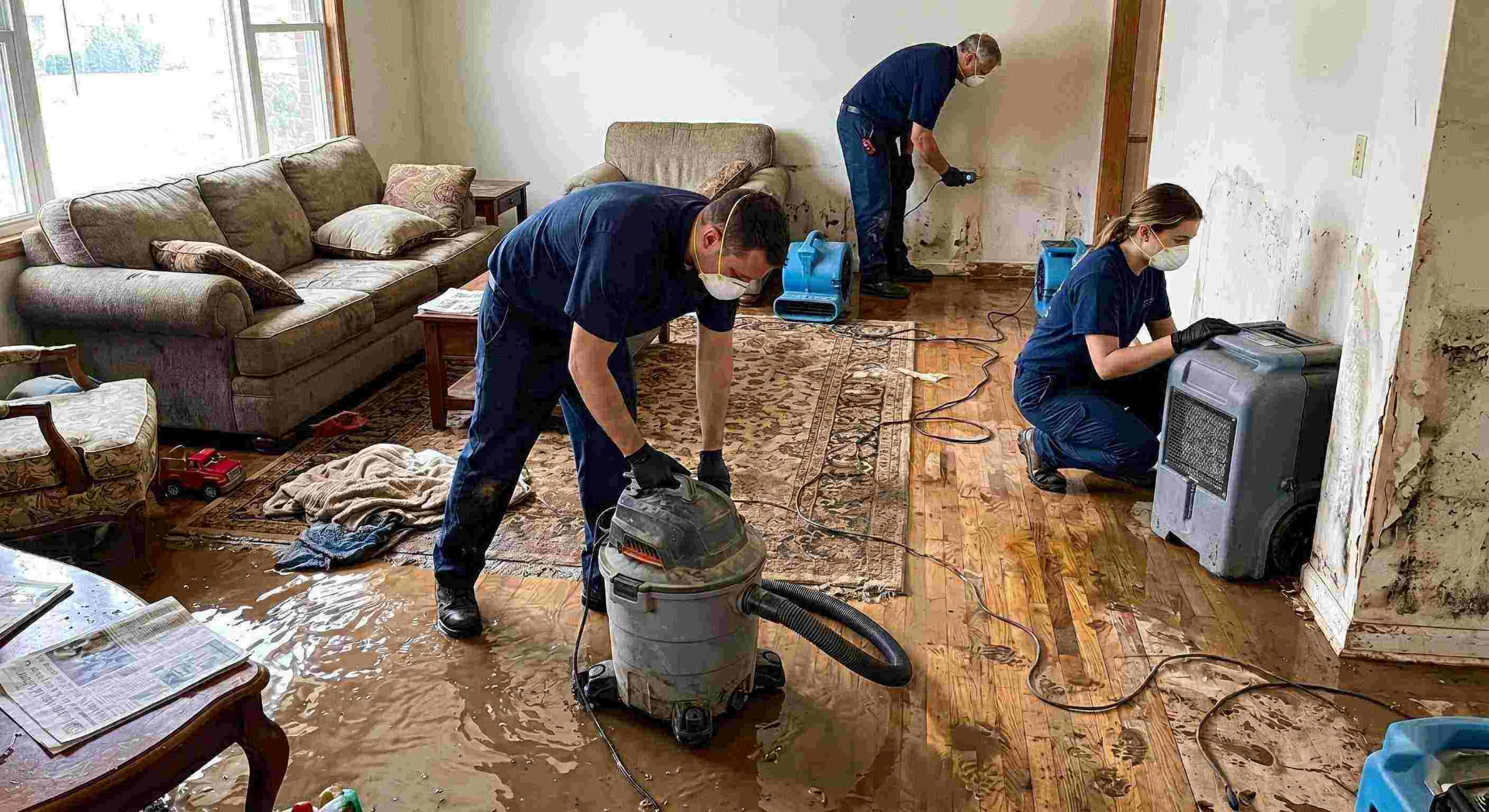
Water damage restoration that actually gets things dry
Burst pipes, failed water heaters, roof leaks, and storm flooding. We connect Seattle-area homeowners with crews that extract standing water, dry the structure to measurable standards, and document every reading for your claim.
Emergency water extraction
Structural & crawlspace drying
Moisture mapping with daily logs
Antimicrobial treatment
Carpet, pad & flooring removal
Reconstruction coordination
Our process
1
Inspection & moisture mapping
We find every wet cavity with meters and thermal imaging — not just what's visible.
2
Extraction
Truck-mounted and portable extraction removes standing water fast to limit secondary damage.
3
Drying & dehumidification
Air movers and commercial dehumidifiers run until readings hit dry standard.
4
Verification & handoff
Final readings, photos, and a line-item scope go to you and your adjuster.
Warning signs you shouldn't ignore
Most of the expensive jobs we see in King and Pierce County started as something small that looked survivable for a few weeks. These are the signals worth acting on.
Buckling or cupping floors
Hardwood that lifts at the seams means moisture is already in the subfloor, not just on the surface.
A musty smell with no visible water
Odor is usually the first evidence of a leak inside a wall cavity or under a crawlspace vapor barrier.
Stains that reappear after painting
A recurring ceiling ring means the source is still active above the drywall.
Spiking water bill
An unexplained jump of even a few thousand gallons often traces to a slab or supply-line leak.
Cold, damp rooms over a crawlspace
Saturated insulation loses R-value and transfers moisture into the floor system.
Peeling baseboards or soft drywall
Gypsum wicks water upward; softness at the base means the wall assembly is wet.
Why the first 48 hours decide the cost of your loss
Water damage is not a single event — it's a timeline. In the first few hours, water is still clean and confined to surfaces, and most materials can be dried in place. By hour 24 it has wicked into drywall, insulation, and subfloor, and swelling begins in engineered wood and particleboard. Somewhere between 24 and 48 hours, microbial growth starts on organic materials in the damp, moderate temperatures typical of a Puget Sound home.
That progression is why two identical burst pipes can produce a $3,000 job and a $30,000 job. The variable is almost never the amount of water. It's how long the structure sat wet, and whether anyone measured what was actually saturated instead of guessing from what looked wet.
It's also why we ask for details up front. Where the water came from, how long it ran, and what it touched determines the equipment plan and the category classification your insurer will use.
Categories and classes: the language your adjuster uses
Restoration work follows the IICRC S500 standard, which sorts water losses by contamination category and by how much of the structure is affected. Knowing which bucket your loss falls into tells you a lot about whether materials get dried or removed.
Category 1 (clean water): supply lines, water heaters, rainwater. Most materials are salvageable if drying starts quickly.
Category 2 (grey water): dishwasher and washing machine discharge, toilet overflow without solids. Carpet pad and some porous materials come out.
Category 3 (black water): sewage backup, river and storm flooding, or any Category 2 loss left wet for days. Porous materials are removed, not dried.
Class 1–4 describes how much material is wet and how hard it is to dry — a wet concrete slab or plaster wall (Class 4) needs specialty desiccant drying, not just fans.
How structural drying actually works
Drying is not fans pointed at a puddle. It's a controlled balance of airflow, dehumidification, and temperature, monitored with readings taken at the same points each day. Air movers push moisture from materials into the air; dehumidifiers pull it back out and keep the room's vapor pressure low enough for evaporation to continue. Take away either half and the moisture just relocates into a wall or ceiling somewhere else.
A properly run job has a dry standard defined at the start — usually moisture readings from an unaffected area of the same material — and equipment stays in place until affected areas match it. Homeowners often want the fans gone by day three because they're loud. Pulling equipment early is the single most common reason a repaired home develops mold four months later.
In Western Washington, ambient humidity works against you. Outdoor air in October through April is frequently too wet to help, so crews close the structure and rely on refrigerant or desiccant dehumidification rather than open windows.
What water damage claims look like in Washington
Standard homeowners policies in Washington cover sudden and accidental discharge of water from plumbing, appliances, and HVAC systems. They generally exclude gradual leaks, seepage through foundations, and surface flooding — flooding from rivers or storm surge requires separate flood coverage, which matters in the Green River and Puyallup River valleys.
Coverage disputes almost always come down to onset: was this sudden, or had it been happening? Photographs taken before demolition, moisture readings that show a defined wet perimeter, and a documented failure point are what settle that question in your favor. So does reporting promptly — most policies require notice without unreasonable delay and reasonable steps to prevent further damage.
Keep receipts for anything you do yourself, including a shop-vac rental or a plumber's after-hours call. Mitigation costs are typically reimbursable under the same claim.
What you can do before a crew arrives
If it's safe, these steps limit the loss and strengthen the claim file. If water is near electrical panels or outlets, or if the source may be contaminated, stop and wait.
Shut off the water at the fixture stop or the main, and kill power to affected areas at the breaker if it's safe to reach.
Photograph everything before you move it — wide shots of each room plus close-ups of the failure point.
Lift furniture onto blocks or foil, and pull area rugs off wet hardwood before dyes transfer.
Remove standing water with a wet vac if you have one; don't use a household vacuum.
Open interior doors and closets so air can reach cavities, but keep exterior doors and windows closed in wet weather.
Don't tear out drywall or flooring yet — premature demolition destroys the evidence your adjuster needs.
What this work typically involves
Ranges below reflect typical residential scopes in the Puget Sound market. Every property is different — your written assessment is the only number that matters for your claim.
Scope
Typical range
What drives the number
Small clean-water loss (one room)
$1,200 – $4,000
Extraction plus 3–5 days of drying equipment
Multi-room or two-floor loss
$4,000 – $12,000
Ceiling assemblies, insulation removal, more equipment days
Crawlspace flooding
$2,500 – $9,000
Vapor barrier and insulation replacement, access difficulty
Category 3 / sewage loss
$7,000 – $25,000+
Removal of porous materials, disinfection, containment
Reconstruction after mitigation
Quoted separately
Flooring, drywall, paint, cabinetry, permits
Ranges are general Puget Sound market estimates for planning only, not a quote. Your written assessment and your carrier's approved scope govern actual cost.
Common questions
How fast should water damage be addressed?
Within 24-48 hours. After that, mold growth and swelling of building materials become likely, which increases both cost and scope.
Will my insurance cover this?
Sudden and accidental water losses are usually covered; long-term seepage often isn't. We document the cause and timeline so your carrier has what it needs.
Do I have to tear out my floors?
Not always. Many hardwood and tile assemblies can be dried in place with specialty drying mats when we get there early.
How long does drying take?
Most residential jobs run three to five days of equipment. Dense materials like plaster, hardwood over subfloor, and concrete can take a week or more.
Is flooding from a river covered by homeowners insurance?
No. Surface water and river flooding require separate flood insurance, which is worth checking if you're in the Kent, Auburn, Sumner, or Puyallup valley floors.
Can I stay in my home during drying?
Usually yes for clean-water losses, though equipment is loud and warm. Sewage losses and jobs with large containment areas often require temporary relocation.
Water Damage help near you
We route requests to vetted local crews throughout King and Pierce County. Pick your city for local conditions and coverage details.